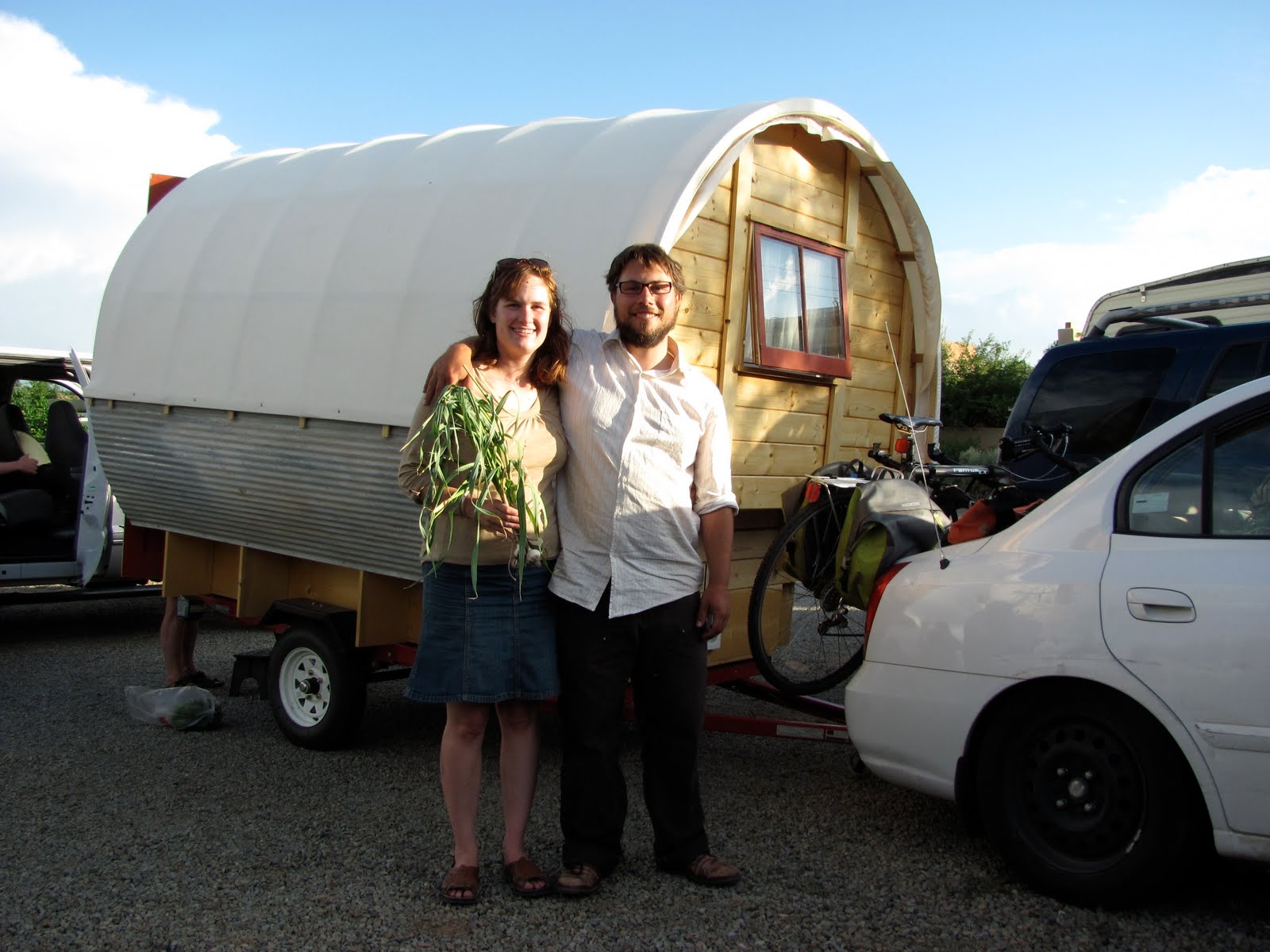
Our friend Alan at the
Sunflower River Community in Albuquerque
wrote on Sunflower River's blog that Mary and I are "
nomadic communitarians". Alan believes (and has observed) that there is a growing culture of nomadic Americans who are consciously choosing to live itinerant lives apart from the mainstream norm of being rooted in one geographic location. I have read some theories that nomadic lifestyles will actually become more popular---and necessary---over the coming decades as homeownership and the trappings of the so-called "American Dream" become less economically feasible for more and more individuals and families.
As far as American nomads are concerned, there are indeed a variety of subcultures that we have observed:
Retired full-time RV'ers: Of course, there are the many full-time RV'ers---mostly retired couples---who choose to live on the road and have the economic support of pensions, Medicare, Social Security, and a lifetime of investments and savings. They live in campgrounds, often volunteering as hosts at national parks, national monuments and even private campgrounds in exchange for a place to live and park their rig.
Younger full-time RV'ers: Like us, there is a small subculture within the full-time RV population that are younger, not retired, and either living full-time temporarily as they look for a new place to call home, or who are able to earn enough money on the road without settling down in any one place for too long. Younger full-timers also volunteer as campground hosts, or find temporary work in a variety of industries. Some work online and simply don't need or desire a "sticks and bricks" home at all.
WWOOF'ers: Worldwide Opportunities on Organic Farms (formerly known as
Willing Workers on Organic Farms---www.wwoof.org) is a global network of organic farms that provides opportunities for "WWOOF'ers" to live and work in exchange for room, board and an education in sustainable living. Many young people travel the world as WWOOF'ers, and although a majority appear to be college-age young adults taking time off from school or simply WWOOF'ing over summer vacation, there is apparently a growing WWOOF'er subculture of young adults who see it as an economically viable way of life. Exchanging labor for room and board provides not only shelter and food, it also builds community and a sense of connectedness.
Skilled laborers: In some campgrounds---especially urban ones like in El Paso, Texas---we have observed groups of (mostly) men who travel the country in mobile homes to wherever their skills are needed. Many campgrounds charge anywhere from $150 to $300 per month for a "full hookup" (electric, water and sewer), so a skilled laborer who is able to travel in his or her own rolling home can pick up and move to wherever work is most plentiful. I believe that this will become an increasingly popular way of life as the economy declines in various parts of the country. I believe that those who are most skilled and mobile can best capitalize on the changing economic fortunes in varying regions of the country at any given time.
Homeless youth: I also believe that there is a growing population of homeless youth in the United States, youth who for one reason or another are disconnected from family and community, and live on the road in cities and towns across the country. When we lived in New England, we observed this phenomenon in southern Vermont as well as Massachusetts, and it seems that this subculture of young adults has been essentially ignored by the larger society, and very few services exist to support this group which I see as highly vulnerable. Without universal health insurance, affordable housing and affordable college education, many young adults are essentially left out, and some understandably choose to live an itinerant lifestyle, far removed from mainstream culture.
I'm sure that there are groups that I'm overlooking or forgetting at the moment, and I hope that readers will chime in with comments, additions and questions. Like the
Roma (the true name of the gypsy culture), there are many Americans who currently choose to live a peripatetic lifestyle for a variety of reasons. Some may feel disaffected from the the larger society and choose to live on the fringes. Some are simply seeking an affordable and mobile way of life, while others may simply be in transition.
For the moment, at least, Mary and I are a part of the itinerant American subculture, and it is fascinating to observe others who are doing the same, often for very disparate reasons. While we are currently feeling drawn to settle down and grow some roots in a place of our choosing (at least for a while), traveling is in our collective and individual blood, and I have no doubt that we will again be on the road eventually. For myself, I have felt like a traveler for the last twenty years---albeit a traveler who was essentially in one place for most of that time. Our current lifestyle is indeed scratching that itch, and I can foresee a time when we will pull up stakes and create a life wherein we can roam the country---or other countries---earning a living either online or along the way.
In the coming years, as the economic fortunes of the country shift and different regions falter or sputter, those of us who are less invested in any particular place will have an easier time weighing anchor and sailing for more prosperous shores.
The brilliant musician
Robert Fripp once called himself "
an intelligent mobile unit", and he stated that "
the future unit of organization is the small, mobile, and intelligent unit where intelligence is defined as the capacity to perceive rightness, mobile the capacity to act on that perception, and small the necessary condition for that action in a contracting world."
In such a "contracting world" (read "economy"), mobile and community-minded individuals and families may stand the greatest chance of success. Sustainable intentional communities are one way in which groups of people are pooling their resources and preparing for economic times when communal living and the sharing of collective energy will be a source of strength and viability.
Our search for community revolves around the notion that living in community is a way to hedge our collective bets and work together to create ways of living that are indeed sustainable and economically feasible. We hope to find a community where we can live with others and share our gifts, either for the long- or short-term. While we are indeed currently nomadic communitarians, the notion of rooting ourselves to a place, a group of people and a piece of land is beginning to feel like the right course of action, and when that place manifests, our lifestyle will necessarily shift away from the nomadic. For now, we nomads will continue our journey and our quest, and the next chapter of our lives waits patiently to manifest itself before our very eyes.
---Keith